

Acceleration Of A Hockey Puck
1. Introduction
The physical properties of ice hockey sticks are described on many web sites, and include things such as weight, length, flex, flex point, kick point, feel, durability, residue, power, release time, and so on. In that location are a lot of variables to consider if a histrion is trying to choose a good new stick or is attempting to compare the performance of different sticks. The significance of each of those backdrop is often a thing of personal preference, merely can be evaluated in more than detail by considering the physics of hitting a hockey puck. Starting with the simplest ideas first and then working out more than technical details, it is possible to figure out which are the most important properties and which are the least important. To that end, we will consider iii dissimilar hockey stick models in plough, starting with the simplest starting time.
two. Abiding Force Model
The primary objective of hitting a puck with a stick is to project the puck at whatever speed the player wants and in whatever direction he or she wants it to go. To practise that the player needs to exert a force on the puck. If a abiding force F is applied for a short fourth dimension T, and if the puck has mass m and is initially at rest, then the puck will advance to a speed five given by v = aT where a = F/m is the acceleration of the puck. For case, if F = 100 N, T = 0.04 s and m = 0.17 kg, and so a = 588 yard/southward2 and v = 23.five m/s. Given that the acceleration to to gravity is 9.8 thou/stwo, the dispatch of a puck is huge by comparison. A higher puck speed volition result if the force on the puck is increased or if the forcefulness is practical for a longer fourth dimension. That should be intuitively obvious, but the numbers and units involved may not be familiar to some readers.
In physics, 1 meter = 3.28 feet, 10 m/s = 22.four mph, ane kg = grand gram = 2.205 lb and 10 Newton = two.25 lb forcefulness.
The numbers here are typical in water ice hockey, and are easy to understand, simply I doubtable that most players and coaches rarely think well-nigh the game in these terms. Withal, it helps to empathise the basic physics if you want to understand what happens when you strike a hockey puck.
In the above example, the puck traveled a relatively long way before the stick stopped pushing it. The distance S traveled during the fourth dimension T is given past South = 0.5aT 2. In this case the puck traveled a distance of 0.47 m. If you double the force to 200 N, and apply information technology for the aforementioned time, then the puck will reach twice the speed and will travel twice as far in getting upwardly to speed. Alternatively, if yous double the time while pushing the puck, maintaining the same force, then the speed volition double and the distance traveled by the puck will increase past a factor of four.
Another way of describing the physics is to consider the free energy of the puck. Its kinetic energy is 0.5mv 2 which is 47 Joules for a 0.17 kg puck moving at 23.five k/due south. The puck acquired that free energy by being pushed with a forcefulness F = 100 Northward over a altitude South = 0.47 m. The work done was FS = 100 ten 0.47 = 47 Joules, and so the kinetic energy was also 47 Joules. That is a uncomplicated example of the "Work-Free energy" principle in physics.
That is the essence of getting the puck up to speed. Flex, balance signal, stick weight, feel and most of those other things we listed above feature in more subtle ways. A point of interest is that it is the thespian who does all of the work and who pushes the puck forwards. The stick itself does nil in the way of useful piece of work. Nothing will happen if the player just holds the stick limply and expects the stick to do all the work. However, the thespian will have little success if the stick weighs only fifty grams or if information technology weighs 10 kg or if it is only two feet long. Similarly, a golf guild or a baseball game bat could be used to strike the puck, merely those implements would not work well either. The stick needs to be designed to exercise the task that information technology was intended to practise, and that includes moving the puck around deftly at low speed by tapping the puck gently. That is why a hockey stick has a low-cal, curved blade rather than a heavy order at the hit end, and why it is five anxiety long rather than two feet long. In the same way, yous could utilise a screwdriver to strike a boom, but a hammer works better.
Flexing the Stick
There are two basic ways that hockey players tin can apply a force to the puck. Either manner will work and both together work even meliorate. One mode is to apply the kinetic free energy of the moving stick. The other fashion is to use the rubberband energy stored in the stick when it bends. The starting time way involves hitting the puck, in the same fashion that a tennis player hits a tennis ball. In that instance, the stick is first accelerated by the player and then the stick collides with the puck. As a event, a big forcefulness is exerted on the puck for a short time. Energy and momentum are transferred first from the thespian to the stick and then from the stick to the puck. The process is non very efficient since neither the player nor the stick comes to a expressionless terminate when striking the puck. In that respect, a lot of free energy is left over or wasted, but that is the price to pay when heavy artillery are used to advance a light puck (or a calorie-free golf ball, or baseball or tennis ball).
The other mode is to curve the stick without accelerating it, in the same style that an archer shoots an arrow out of a bow. In that case, it is elastic energy in the stick that is used to utilize a force to the puck, rather than the kinetic energy due to its forward move. If the stick is pushed against the ice then that it bends, so the stick stores rubberband potential energy that can exist released when the player is ready. If the stick is lifted quickly off the ice, the stick springs back to its usual straight position and can therefore be used to propel the puck frontwards.
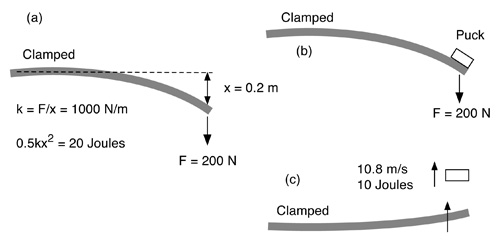
Effigy one — A hockey stick clamped at the butt terminate and the middle. A forcefulness F is applied at the bract end. If a puck is placed on the bract and if F suddenly decreases to cypher, the puck will shoot in the air and the stick will vibrate.
The essential features of stick bending can be illustrated by clamping a horizontal stick to a table, as shown in Fig. one. If a vertical force F is applied at the bract end, then the stick will bend and the blade will move through a distance x. The distance x is proportional to F, so we tin can permit F = kx where k is the stiffness of the stick. If the length of the overhanging stick is small then the stick will be hard to bend and k will be large. The stiffness therefore depends on the bending length just is typically near 1000 N/1000 for a hockey stick held or clamped nearly the handle end and near the heart of the stick. In that case, a force F = 100 N will bend the stick through a distance x = 0.i one thousand and a forcefulness F = 200 N will bend the stick through a distance x = 0.two one thousand.
If a puck is placed on the cease of the stick in Fig. 1 and the force is suddenly released, the puck will shoot up in the air. The stick volition not come to a expressionless end when the puck leaves the stick since the stick itself is moving up at maximum speed at that fourth dimension. The stick therefore overshoots the horizontal position and bends in the contrary direction. The stick will then terminate up vibrating back and forth later on the puck leaves the stick, although those vibrations would be quickly damped by the hands and arms and gloves if the stick was held by hand instead of being clamped to the tabular array.
Movie Screen 1 presents an example of launching a puck this way.
Puck Launch
Movie Screen one — Puck Launch. (Note: By using the forward and backward double arrow keys, you can go forward and astern a frame at a time.)
The elastic energy stored in the stick is given past 0.5kx 2. For example, if thou = k N/g and 10 = 0.2 m, and so the stored energy is xx Joules. In theory, that energy could be used to launch a puck at a speed of 15.3 m/s since the kinetic energy of the puck would so be 20 Joules. However, part of the stored elastic energy is used to accelerate the stick itself. If the aptitude section of the stick weighs 0.17 kg, and the puck weighs 0.17 kg, and then roughly half the elastic free energy will be given to the puck and the other half is used to advance the stick.
Suppose that the puck accelerates to 10.8 m/southward and ends up with 10 Joules of kinetic energy. It was accelerated over a distance of 0.ii m and traveled that distance at an average speed of 5.iv m/s so information technology took 0.037 due south to accomplish maximum speed. That is the release time of the stick. The release time can exist shortened by using a stiffer stick or by moving the lesser hand closer to the bract so the stick bends over a shorter length.
Suppose that thou = 2000 Northward/1000 instead of thou Northward/one thousand and the same 200 N strength is used to curve the stick. Then x = 0.1 yard and the stored free energy is 0.five x 2000 10 0.12 = ten Joules. To get the aforementioned 20 Joules as before, the force would need to be increased to 280 Due north, giving x = 0.xiv grand. If the puck is ejected at 10.8 yard/southward as earlier, catastrophe upwards with 10 Joules of energy, and then it accelerates over a distance of 0.xiv 1000 at an boilerplate speed of five.4 m/s. In that case, the release time is 0.14/5.4 = 0.026 seconds. The player can therefore release the puck sooner with a stiffer stick but has to button harder on the stick to bend information technology, and ends up with the same puck speed.
The puck speed that can be imparted just by bending the stick is not very big. More normally, players button or flick the stick forward while angle it, in order to increment the force on the puck. Fifty-fifty higher puck speeds outcome when the stick is start accelerated and and then collides with the puck.
3. Standoff Model
A simple standoff is shown in Fig. 2 where a heavy object of mass Grand moving at speed 5 collides head-on with a lighter object of mass m initially at rest. The heavy object volition slow downward and transfer some of its momentum and energy to the lighter object. The low-cal object will so take off at speed v due to the force exerted on it past the heavy object. The terminate result is the same as pushing with a abiding force, just when collisions are involved the forcefulness does not remain constant. The forcefulness starts out at zero when the objects first come into contact, increases to a maximum, then decreases to zero again when the objects lose contact.
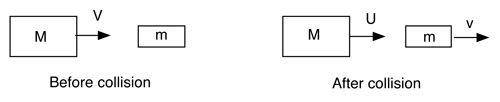
Figure 2 — The standoff of a large mass Grand with a small-scale mass k initially at rest.
Suppose that a hockey stick of mass M collides with a puck of mass m. The stick is first accelerated to some speed V by the player, and then the stick collides with the puck. For case, if Chiliad = 0.4 kg and V = 20 m/south then the kinetic free energy of the stick is 0.5MV 2 = 80 J which is more than enough to accelerate the puck to a speed greater than 20 m/s.
The bodily speed of the puck can be calculated by bold that at that place is no loss of energy during the collision and that the duration of the collision is sufficiently brusque that the player doesn't take time to add whatever more free energy or momentum to the stick or the puck during the collision itself. That is non quite true, only it simplifies the calculation and the answer is approximately correct.
If the momentum remains constant then
MV = mv +MU
where U is the stick speed after the collision. If the total energy remains abiding and so
0.5MV 2 = 0.5mv ii + 0.5MU 2
Another way of stating that the energy remains constant, and one that simplifies the calculation even further, is
v - U = V
which means that the relative speed later the collision is the aforementioned as the relative speed before the collision. In that instance, we tin can solve these equations to show that
v = 2MV / (1000 + M)
For example, if V = twenty m/s, Thou = 0.four kg and m = 0.17 kg and so five = 28 chiliad/s. The puck therefore takes off at a higher speed than the incident stick. The puck gets its free energy from the stick, so the stick slows downwards since it lost free energy when information technology gave it to the puck. Note that we accept worked out the speed of the puck without knowing anything almost the forcefulness on the puck or the time it took to accelerate to that speed, and without knowing annihilation about how far the stick bent. We don't need to know anything nearly the stick angle, and it doesn't actually thing how far it bent. The same answer would be obtained if the stick was very stiff or if information technology was very flexible. It is clear from this result that the puck did not go its energy from the bending of the stick. It got it from the kinetic energy of the stick. The stick had that energy before it collided with the puck and before the stick started to bend.
A question of interest is how nosotros can maximise the speed of the puck. The answer depends on how we vary the other quantities. For example if we keep 1000 and one thousand the aforementioned, and then the answer is simple. That is, we can increase v merely by increasing V. Even so, that means we would demand to increase the kinetic energy of One thousand so the actor would need to do more work. Alternatively, suppose we keep V and thou the same and vary M. Then v increases every bit M increases. Once again, the role player needs to do more work.
Suppose the kinetic energy of M remains abiding. And then the effort expended past the actor remains the same. Information technology turns out that v is a maximum when One thousand = grand. In that instance, the stick would need to be as light as the puck and the stick would come to a dead cease and give all its free energy to the puck. However, that is not a practical solution since the histrion can put more free energy into a heavy stick than into a low-cal stick, given that most of the endeavour of the player is used in swinging the heavy arms. Adding a 400 gram stick to the arms does not deadening downwards the arms very much, so a 400 gram stick will have more energy than a 170 gram stick, with very little extra free energy or endeavor required by the player. A 1 kg stick would accept even more energy, the aforementioned as a baseball bat, just would be difficult to maneuver into position apace.
Force Arising from the Collision
Whenever 1 object collides with another, each of the objects exerts a large force on the other. The magnitude and elapsing of the force depends on the stiffness of the two objects. If both objects are very stiff and so the force will be very big just it will act for only a very short time. If one or both objects are very soft then the force will be small merely information technology volition concluding for a long time. As described previously, the end result depends on FT (force times time) so a large force interim for a short time tin accelerate an object to the aforementioned speed as a pocket-size force acting for a long fourth dimension. For instance, when a baseball bat collides with a baseball, the collision lasts only 0.001 seconds, but a huge force is exerted on the ball. When a hockey stick collides with a rubber puck, the forcefulness lasts about 40 times longer and is almost xl times smaller since the stick is much softer than a baseball bat. The puck itself has most the same stiffness as a baseball.
In a bat and ball standoff, the very large force squashes the ball and bends the bat. When a hockey stick collides with a puck, the puck squashes slightly and the stick bends due to the force on the stick. The force on the puck is equal to the force on the stick but acts in the contrary management. Equally a result, the puck speeds up and the stick slows down.
A similar result occurs if you drop a brawl on the floor. The ball collides with the flooring and bounces up once more since the force keeps pushing upwards until the ball bounces off the floor. In the procedure, the ball squashes and then expands back to its original size. However, the ball doesn't bounce just because it was squashed. That is only office of the story. The kinetic energy gained past the ball equally it fell was converted to rubberband energy when the ball came to a stop one-half way through the bounce. The elastic energy was then converted back to kinetic free energy when the ball bounced up once more.
In a like manner, kinetic energy is given to a stick when the histrion swings information technology. During the collision with the ice and the puck, the stick bends as it slows downwardly and stores rubberband energy. That elastic energy is and so given to the puck. A small amount of elastic energy is besides stored in the puck when it squashes, and some of that is released as kinetic energy as the puck loses contact with the stick. However, most of the elastic energy stored in the puck is lost since pucks do not bounce very well. If a puck is dropped from a peak of 1 m onto a difficult surface and bounces on its edge, it will bounce to a height of but near 0.1 one thousand.
If a strength F is applied to the blade of a stick, and if the stick is held firmly by ii hands in the usual way, then the blade and the end of the stick volition bend through a distance x. For a typical stick, 1000 = 1000 Due north/m. If F = 100 N and then x = 0.1 m. That is a typical strength on the blade when it impacts the water ice, so the stick will bend by about 10 cm. If F increases to 200 N when the blade strikes the puck and so the stick will bend about twenty cm. When the stick bends ten cm, the elastic free energy stored in the stick is 5 Joules. When information technology bends 20 cm, the elastic energy is 20 Joules. A puck traveling at thirty m/s has 76 Joules of kinetic energy. Evidently, it does not get all its energy from angle and straightening of the stick. It gets most of its free energy equally a result of the player pushing the stick and accelerating both the stick and the puck. In the process, about 20 Joules is temporarily stored as elastic free energy when the stick bends, but nearly of that is given back when the stick straightens out.
iv. Rotation Model
There are three problems with the simple collision model. The first is that the role player does not terminate pushing the stick when the stick collides with the puck. The histrion keeps pushing and accelerating the stick throughout the collision. The second trouble is that the stick does not move in a straight line. It moves in a circular arc. The 3rd problem is that the puck is struck at the far end of the stick rather than in the middle. All of these problems can exist eliminated by assuming that the stick rotates about a fixed centrality near the meridian end and is pushed by the player with a force F near the middle of the stick. The puck is struck at the far end of the stick. To allow for the fact that the stick bends elastically, a spring can be inserted between the puck and the far stop of the stick, every bit shown in Fig. 3.
Effigy three looks complicated, but it is non. The stick swings about an axis most the top, like a pendulum. Still, it differs from a ho-hum-moving pendulum in that it is swung quickly by the thespian who exerts a large force F at right angles to the stick at a distance R from the axis. As a result, the stick rotates at angular velocity ω, measured in radians/sec where one radian = 57.three degrees. Typically, a hockey stick rotates at about 20 radians/s = 1146 degrees/south in a slap shot, or by about 46 degrees in 0.04 seconds.
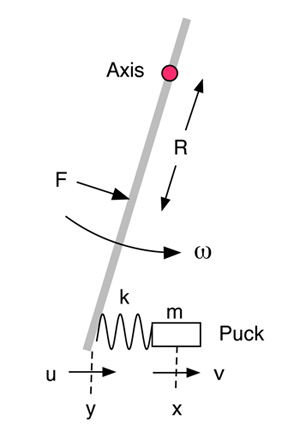
Figure 3 — A stick rotating nearly a fixed axis. The role player exerts a force F at distance R from the axis. The flex of the stick is represented by a spring of stiffness grand.
The lesser end of the stick moves to the right at speed u = Lω where L is the distance from the axis to the bottom stop of the stick. For instance, if L = one.4 m and ω = 20 rad/s, then u = 28 m/s. The puck has mass thou and moves to the right at speed 5 = dx/dt where x is the horizontal coordinate of the puck. If y is the horizontal coordinate of the bottom end of the stick and so u = dy/dt. The spring between the puck and the stick has stiffness chiliad and is compressed by an amount y - ten then the force on the puck is Fp = m(y - x). An equal and opposite force is exerted past the bound on the bottom end of the stick.
The equations describing the motility of the puck and the stick are respectively:
(1) m(dv/dt) = k(y - 10)
and
(2) τ = FR - chiliad(y - x)Fifty = I0(dω/dt) = (I0/L)(du/dt)
where τ is the torque about the axis and I 0 is the moment of inertia of the stick virtually the centrality.
I 0 is commonly known every bit the swing weight and is typically about 0.45 kg x m2 for an water ice hockey stick. The value of I 0 for a uniform shaft of length L and mass Thou is ML ii/iii = 0.eighteen kg x one thousand2 if M = 0.three kg and L = 1.35 thousand. To that we need to add K b L b ii = 0.27 kg ten grandtwo for a bract of mass Thou b = 0.12 kg and L b = ane.5 m, giving a total value I 0 = 0.45 kg x m2 for this particular stick. If the shaft is tapered, with more weight at the handle end and less at the blade end, then I 0 will exist smaller.
In Eqs. (one) and (2), it is causeless that the axis is stock-still and the player is not moving forwards. If the role player is moving forwards at say 5 m/s while swinging the stick, we can only add 5 g/southward to the final puck and stick speed results, even though the bodily swing axis will then be in a dissimilar location. It is necessary but to change the reference frame, moving along at the aforementioned speed as the player, to bring the swing axis dorsum to its assumed, calculated location.

Acceleration Of A Hockey Puck,
Source: https://twu.tennis-warehouse.com/learning_center/hockeyphysics.php#:~:text=If%20the%20puck%20is%20ejected,speed%20of%205.4%20m%2Fs.
Posted by: tyernage1964.blogspot.com
0 Response to "Acceleration Of A Hockey Puck"
Post a Comment