

Relationship Between Moles And Volume
The platonic gas Law
Where does this come from?
Robert Boyle plant
That is, the product of the pressure of a gas times the volume of a gas is a constant for a given sample of gas. In Boyle's experiments the Temperature (T) did not change, nor did the number of moles (n) of gas nowadays. So Boyle found
but did not explore the effect the temperature, or the number of moles would accept on pressure and volume.
Jaques Charles constitute
That is, the volume of a given sample of gas increases linearly with the temperature if the pressure (P) and the amount of the gas (n) is kept constant. So Charles constitute
Avagadro'south Postulate
At the same temperature and pressure equal volumes of all gasses comprise the same number of molecules.
V = n (RT/P)
Guy Lussac found that i volume of Cltwo combined with i volume of H2 to make 2 volumes of HCl. The equation for the reaction is

With this example we tin can clearly see the human relationship between the number of moles of a gas, and the volume of a gas.
At abiding temperature and pressure the volume of a gas is directly proportional to the number of moles of gas.
Not so coincidentally if V is constant instead of P and so
At constant temperature and book the pressure level of a gas is straight proportional to the number of moles of gas.
Yous could remember all the different gas laws,
Pane/Ti = P2/Tii
Five1/T1 = Fivetwo/Ttwo
and then on...
Or you could recall nigh the problem a bit and use PV=nRT.
N2O is placed in a piston. Initially the volume of the piston is 3.0 L, and the pressure level of the gas is 5.0 atm. The piston is used to compress the gas to a volume of 1.5 Fifty; determine the pressure level of the N2O.
well, before the compression
or

afterward expansion
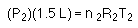
since n, R, and T do not change

substituting

P = 1.0 x ten L
Encounter, if you lot forget all those different relationships you lot can just employ PV=nRT.
A PV = nRT problem
What is the book of ane mole of an platonic gas at STP (Standard Temperature and Force per unit area = 0 °C, i atm)?
(1) 5 = 1(0.08206)(273.fifteen)
V = 22.41 L
So, the book of an ideal gas is 22.41 L/mol at STP.
This, 22.4 L, is probably the nigh remembered and least useful number in chemistry.
Another case
What is the volume of 5.0 thousand NH3 at 25 °C and 1 atm. of pressure level?
Well we just found that the book of 1 mole of an ideal gas is 22.41 50 and so nosotros can use this as a conversion gene...right?

Everyone remembers that 1 mol of an platonic gas occupies a volume of 22.4 Fifty, only this is probably the to the lowest degree useful number in chemistry. Alot of people forget that this relationship is simply true at STP (0 °C and 1 atm.).
So, utilise
To employ PV=nRT we demand to have moles of NH3.

Information technology is not practical to employ PV=nRT equally a conversion in a gene label problem so we volition only solve for V.

V = 7.eighteen = 7.2 L NH3
Some other Problem
Seltzer water is fabricated by dissolving CO2 in water. Seltzer can be made at home using modest containers of pressurized CO2. If one of the cartridges contains 20.00 mL CO2 at 55.00 atm at 23.0 °C and it expands into an empty seltzer canteen with a volume of 1.000 L and the resulting pressure is 1.000 atm what is the temperature of the gas.
Before the gas expands...

and
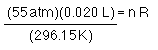
after the gas expands...

or
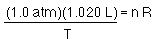
since R has not inverse (it is called the universal gas Abiding for a reason) and nosotros have non inverse the number of moles of COtwo...

or...
continuing the previous trouble
What volition the pressure be when the gas warms to 23.0 °C?
before expansion and warming...after expansion and warming to room temp

once more R and north have not inverse, and at present not even T has non inverse so...

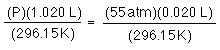
solve for P

Relationship Between Moles And Volume,
Source: https://www.westfield.ma.edu/PersonalPages/cmasi/gen_chem1/Gases/ideal%20gas%20law/pvnrt.htm#:~:text=At%20constant%20temperature%20and%20pressure,number%20of%20moles%20of%20gas.
Posted by: tyernage1964.blogspot.com
0 Response to "Relationship Between Moles And Volume"
Post a Comment