

Silicon Dioxide Lewis Dot Structure
In 1916, an American pharmacist Gilbert Newton Lewis worked on how atoms are connected in a molecule. As a issue of his research, he discovered covalent bonds and adult a method to represent the bonds between the atoms of molecules by using simple structures called lewis electrons or lewis dot structures.
Lewis dot structures are the chemic symbols of elements. They take valence electrons that are manually arranged around the sides of the symbol of elements.
These diagrams are named lewis dot structures considering valence electrons are drawn in the class of dots around the four sides of atoms. A single dot represents an unpaired electron. This electron is responsible for the chemical bond germination when it comes close to the unpaired electron of other atoms. Now, these unpaired shared electrons are called bond pairs.
However, double dots bear witness every bit a pair of electrons on atoms in a molecule called solitary pair. They don't have part in the germination of bonds between the atoms of a molecule or compound.

Lewis structure and lewis dot structure
The concept is the same for both terminologies which are lewis structure and lewis dot construction. The only divergence is the mode of drawing or presenting the structures of molecules or compounds. When a structure of a molecule is drawn and paired electrons are shown in the form of dots and unpaired shared electrons are shown in the form of a solid line called a lewis structure, non a lewis dot structure.
However, in the lewis dot structures, paired and unpaired electrons are shown in the course of dots. The whole construction is a combination of dots that represents electrons. These electrons are not fixed on a specific side of an atom, they tin be drawn on the random sides of elements.
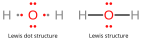
Both lewis structure and lewis dot structure are valid to correspond the structure of molecules but it creates defoliation when we use the solid lines for unpaired shared electrons and dots for paired electrons. That's why it is better to use one blazon of method, lewis structure or lewis dot structure to demonstrate the paired and unpaired electrons of molecules or compounds.
Lewis dot structures of elements
Metal elements tin can lose electrons and form ions. Hydrogen is an exceptional case and when combined with non-metallic elements forms a covalent compound. Still, non-metals have filled s-orbitals and partially filled p-orbitals. They have fixed numbers of electrons in their outermost shell chosen valence electrons.
These valence electrons are equal to the group of the element in the periodic table. For example, boron (B) has three valence electrons in its outermost shell and belongs to group 3A of the periodic tabular array. Similarly, carbon (C) and silicon (Si) have four valence electrons and belong to group 4A. This trend is followed by all groups in the periodic table, groups 5A, 6A, 7A, and 8A.
Lewis dot structures have single and double dots representing unpaired and paired electrons. By counting the number of unmarried dots or electrons on the elements, we can predict the diagram of the element. It is because atoms class covalent bonds to complete their doublet or octet dominion. This can be seen by drawing lewis dot structures of elements.
For instance, hydrogen (H) has a unmarried electron so it can class a covalent bond past completing the doublet rule. Boron (B) has three single electrons, so it can form iii covalent bonds. It does not complete the octet dominion like other elements. Similarly, nitrogen (N) has one lone pair (double dots) and three single electrons (single dots), and fluorine (F) has just one single electron. And then, nitrogen can make three covalent bonds while fluorine can form 1 covalent bond. Neon (Ne) cannot grade whatever bond because information technology has already completed its octet rule and has no single electron.
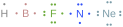
In a compound, when one chemical element shares its unmarried electron with the other element's single electron, they form a chemic bail. For instance, in the case of hydrogen fluoride (HF), hydrogen has a single electron, combined with the unmarried electron of the fluorine to form a chemical bond.

How to depict lewis dot structures
These are the steps to describe lewis dot structures of atoms, molecules, and compounds.
- The first step is to summate the number of valence electrons of every atom in a molecule or compound. This can be found by counting the number of electrons in the outermost shell of the atom. For case, carbon dioxide has a total of 16 valence electrons. Carbon has iv valence electrons and each oxygen has 6 electrons.
- A molecule or chemical compound has more than one blazon of atom nowadays in information technology. The atom which is the least electronegative becomes a central cantlet in the compound.
- At present assign electrons one past one to the atoms. For example, in the case of carbon dioxide, we have sixteen valence electrons and three atoms. Nosotros tin start distributing electrons from any side. 1 electron is given to the first oxygen atom, the second electron is given to the carbon atom, and the 3rd electron is distributed to the 2d oxygen atom. Similarly, this type of electron distributing pattern continues until the 16 valence electrons are completely distributed to the molecule of carbon dioxide.
- Count the full number of valence electrons around each atom. Each atom should be eight electrons and complete its octet. A few elements that do not complete their octets are boron (B) and hydrogen (H).
- When a molecule is an anion. The negative charges on the molecule are added to the counting of the full valence electrons on the molecule.
- In a cation molecule, the positive charges on the molecule are subtracted from the full count of valence electrons.
- Alone pairs are assigned from the near electronegative atom to the least electronegative atom.
- Later assigning lone pairs to the atoms. For atoms that are not completing their octet configuration, double or triple bonds can exist drawn to complete the octet valency of each atom. In some cases, the solitary pairs can exist converted to bail pairs to draw the double or triple bail.
Uncomplicated inspection method
Uncomplicated inspection method is a simple method to calculate all the valence electrons of atoms in a molecule and assign them. In this style, structures of minor and simple molecules can be determined past using the lewis dot structure.
Sometimes, small or complex molecules create bug when assigning double or triple bonds. For example, the lewis dot structure of carbon monoxide (CO) cannot be determined by using a simple inspection method.
Pooled electron method
Pooled electron method is used when the lewis dot structure of molecules cannot be drawn by a elementary inspection method. In pooled electron method, summate the full number of valence electrons and distribute them in such a way that each atom has eight electrons. For case, carbon monoxide (CO) has 10 valence electrons. Carbon (C) has four electrons while oxygen (O) has six electrons. These ten electrons are distributed as the germination of a bail takes identify and each atom has completed its octet.

Lewis dot structure of polyatomic ions
Pooled electron method is used for determining the lewis dot structure of polyatomic ions.
Polyatomic Anions
Lewis dot construction of negatively charged polyatomic ions can exist drawn by adding the negatively charged value in the total valence electron of the ion. For example, sulfate ion (SO4 -2) has a negatively charged value of -2. In the case of sulfate ion (Sofour -2), the sulfur (S) atom contributes six valence electrons while each oxygen atom gives vi valence electrons. Total valence electrons are 30 but adding the negative charge value (-2) gives a total outcome of 32 valence electrons. In this way, the sulfate ion has a total of 32 valence electrons that can be shown in the lewis dot structure.

Polyatomic Cations
To draw the lewis dot structure of positively charged polyatomic ions subtract the positive charge value from the total valence electrons. For example, ammonium ion (NH4 +) has 5 valence electrons of nitrogen (N) atom and 4 valence electrons of four hydrogen (H) atoms giving a total of 9 valence electrons in ammonium ion with a positive charge (+1). When nosotros depict the lewis dot structure of ammonium ion, we subtract the one valence electron from the total number of valence electrons. In this way, 8 valence electrons are shown to draw the lewis dot construction of ammonium ion.

Lewis dot structure of resonance ions
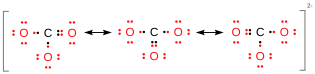
Resonance is due to the delocalized motility of pi-electrons in the structure. In this way, they show unlike structures of the same molecule or ion.
There are some ions or compounds that prove resonance in their structure. So it is a challenge to draw these structures in the form of lewis dot structure. The method is the same to calculate the valence electrons of the atoms but the only difference is the position of the electrons which are delocalized in the structure.
For example, carbonate anion (COiii -two) has 3 equivalent lewis dot structures. In each structure, 1 of the three oxygen atoms has to contribute iv valence electrons (double bonded with carbon atom) instead of 6 valence electrons.
Common examples of lewis dot structures
Lewis dot structure of oxygen (O)

Lewis dot structure of carbon (C)

Lewis dot structure of carbon dioxide (COii)

Lewis dot construction of water (H2O)

Lewis dot structure of chlorine (Cl)

Lewis dot construction of iodine (I)

Lewis dot structure of Sulfur trioxide (SO3)

Lewis dot construction of boron trifluoride (BF3)

Lewis dot structure of carbon tetrachloride (CCl4)

Lewis dot construction of Perchlorate ion (ClO4 –)

Lewis dot structure of hydronium ion (OH3 +)

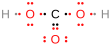
Lewis dot structure of carbonic acid (H₂CO₃)
Lewis dot structure of lithium oxide (Li2O)

Lewis dot construction of hypobromite (BrO–)

Lewis dot structure of chloroform (CHCl3)

Concepts Berg
What is the Lewis dot structure?
Lewis dot construction represents the structure of elements in the grade of dots. These dots are basically valence electrons that tin be paired or unpaired.
How to know where to put the dots on a Lewis structure?
There are some steps to follow to describe the structure. First dots can be distributed to the central atoms, especially alone pairs.
What would be a good method for figuring out how to draw 3-dimensional Lewis-Dot structures?
These are two methods to draw lewis dot structure.
- Elementary inspection method
- Pooled electron method
What is the divergence between lone and bail pairs?
Lonely pairs are paired valence electrons that practice not accept part in a chemical reaction. Withal, bond pairs are unpaired shared electrons that brand the bail between the two atoms.
What is the departure between lewis structures and lewis dot structures?
When the lewis structure is represented with a solid line and dots called the lewis structure while the lewis dot structure has just dots, even bonds are shown in the class of dots.
Reference links
- Lewis dot structure (byjus.com)
- Lewis dot construction of elements (mtsu.edu)
Was this article helpful?

Silicon Dioxide Lewis Dot Structure,
Source: https://psiberg.com/lewis-dot-structure/
Posted by: tyernage1964.blogspot.com
0 Response to "Silicon Dioxide Lewis Dot Structure"
Post a Comment